



Frozen Assets Lawyer
If your bank account or assets have been frozen due to OFAC sanctions, EU restrictive measures, or a false positive SDN hit — our frozen assets lawyers can help you unblock them fast. We have successfully recovered blocked funds for clients in 40+ countries, including emergency releases within 48–72 hours.

Quick Answer
A frozen assets lawyer specializes in unblocking bank accounts, real estate, cryptocurrency, and other assets that have been frozen under OFAC (US Treasury), EU, or UK sanctions. They analyze the legal basis for the freeze, identify whether it results from an SDN designation, a false positive name match, or the 50% Rule, then pursue the fastest available unblocking route — whether that is a direct submission to the financial institution, an OFAC specific license application, or an EU/OFSI derogation request.
Why Are Assets Frozen Under Sanctions?
Asset freezes are one of the most immediate and disruptive enforcement tools in the global sanctions system. In the United States, the Office of Foreign Assets Control (OFAC) administers a list of Specially Designated Nationals (SDN) — individuals, companies, and entities whose assets must be blocked by any US person or financial institution. The moment a name triggers an SDN match, banks are legally required to freeze the account and report to OFAC.

The scope goes further than most clients expect. Under OFAC’s 50% Rule, any entity that is 50% or more owned — directly or indirectly — by one or more SDN-listed persons is itself treated as blocked, even if that entity does not appear on the SDN list. This rule regularly traps innocent third parties: a legitimate business may find its accounts frozen simply because a minority shareholder of its parent company was sanctioned.
EU and UN sanctions designations operate similarly. The EU Council publishes a consolidated list of persons subject to restrictive measures; member states implement freezes through national competent authorities. False positives — where an innocent person name closely resembles a listed party — are frequent and cause significant financial harm to individuals and businesses who have no connection to sanctions violations.
Types of Assets That Can Be Frozen
Sanctions freezes are not limited to cash in a bank account. Under OFAC regulations and equivalent EU/UK rules, any asset in which a blocked person holds an interest is subject to freezing. Common categories include:
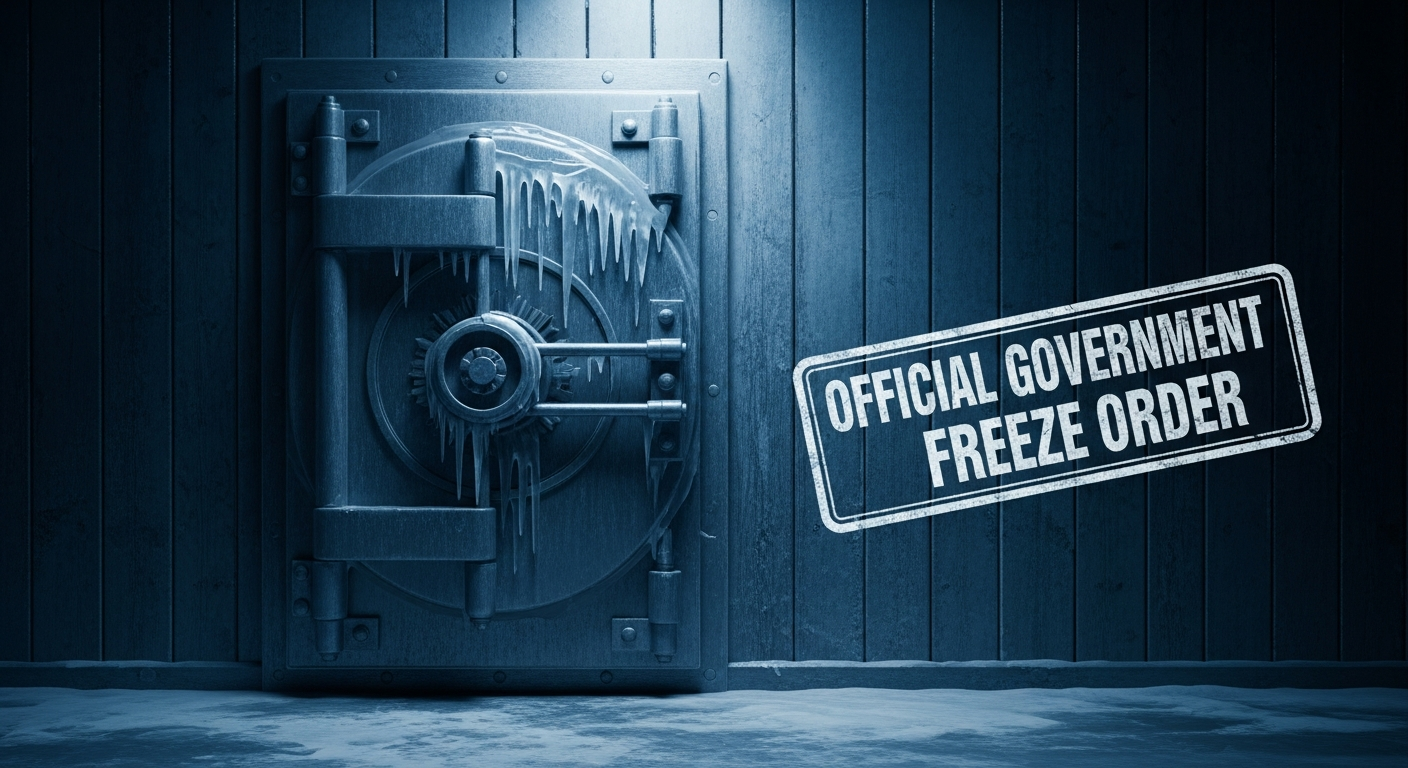
- Bank accounts: Current accounts, savings accounts, and term deposits are frozen immediately upon an SDN hit. Correspondent banking chains mean that even foreign banks may block transfers routed through US-dollar clearing.
- Real estate: Property owned or co-owned by a designated person cannot be sold, transferred, or mortgaged without a license. Rental income is also blocked.
- Cryptocurrency: OFAC has increasingly targeted crypto wallets and exchanges. In 2025-2026, expanded blockchain analytics allow regulators to trace and freeze digital assets linked to SDN addresses. Exchanges are required to block accounts triggering SDN matches.
- Investment accounts and securities: Brokerage accounts, stock portfolios, and mutual fund holdings are blocked. Dividends and interest payments are also frozen.
- Business assets: Inventory, receivables, intellectual property licenses, and contractual rights held by a sanctioned entity or its 50%-owned subsidiaries are all subject to freezing.
| Asset Type | Freeze Authority | Unblocking Route | Typical Timeline |
|---|---|---|---|
| Bank account | OFAC / EU / OFSI | Specific license or false-positive dispute | 48h–6 months |
| Real estate | OFAC / EU | OFAC specific license | 6–12 months |
| Cryptocurrency | OFAC (exchange-level) | License + exchange compliance | 3–9 months |
| Investment account | OFAC / EU | Broker compliance + OFAC license | 4–10 months |
| Business assets (50% Rule) | OFAC | Ownership structure documentation | 2–8 months |
How to Unblock Frozen Assets — The Legal Process
There is no single procedure for unblocking frozen assets — the correct strategy depends on why the freeze occurred and under which regime. A frozen assets lawyer will typically pursue one or more of the following tracks:

1. Direct bank engagement (false positive resolution). If the freeze results from an automated name-match false positive, the fastest route is to submit documentary evidence to the bank compliance team demonstrating that the account holder is not the SDN-listed party. In straightforward cases, this can achieve release within 48-72 hours without involving OFAC at all.
2. OFAC Specific License Application. Where the freeze is confirmed as SDN-related, an OFAC-specific license authorizes a particular transaction or set of transactions involving blocked property. License applications require detailed legal arguments, factual submissions, and compliance frameworks. Processing times average 3-6 months, though emergency humanitarian licenses may be expedited.
3. OFAC Reconsideration and Delisting Petition. If the designation itself is contested — because it was based on incorrect information or changed circumstances — a delisting petition challenges the underlying SDN listing. This is a more complex process taking 6-18 months or more, but it results in permanent removal from the SDN list if successful.
4. Overcompliance disputes. Banks frequently over-block accounts out of caution, freezing assets that are not legally required to be blocked. A frozen assets lawyer can challenge overcompliance, citing OFAC guidance and demanding the bank justify the freeze under applicable regulations.
EU & UK Frozen Assets — Different Rules, Same Urgency
If your assets are frozen under EU or UK sanctions rather than US OFAC measures, the legal framework differs — but the urgency is identical.

EU frozen assets are governed by EU Council regulations, implemented individually by each member state. Releasing frozen EU assets requires a derogation or authorization from the relevant national competent authority. The EU has expanded its sanctions listings significantly in 2025-2026 in connection with Russia, Belarus, and other geopolitical situations, and has introduced tighter reporting requirements for frozen asset holders.
UK frozen assets fall under OFSI (Office of Financial Sanctions Implementation), part of HM Treasury. OFSI issues licences for specific transactions involving frozen assets, with categories including basic needs, legal fees, and prior contractual obligations. Post-Brexit, UK and EU sanctions lists diverge in some designations, meaning a person may be frozen under one regime but not the other — or both simultaneously.
Our frozen assets lawyers work across all three regimes — OFAC, EU, and OFSI — and can coordinate parallel license applications where assets are frozen under multiple jurisdictions.
| Regime | Authority | Unblocking Process | Who Applies |
|---|---|---|---|
| US OFAC | US Treasury / OFAC | Specific license application | US persons + non-US (secondary sanctions) |
| EU Sanctions | EU Council + national authority | Derogation / national authorization | EU/EEA entities and persons |
| UK OFSI | OFSI (HM Treasury) | OFSI license application | UK persons + UK-nexus transactions |
Emergency Help for Frozen Assets
A frozen bank account can halt payroll, block business operations, and prevent access to living expenses within hours. Time matters. The sooner legal counsel is engaged, the more options remain available — including emergency submissions and expedited processing tracks.

We are available 24/7 for emergency consultations on frozen assets cases. When you contact us, please prepare the following information to allow our team to assess your situation immediately:
- The name of the bank or institution that froze the assets and the date of the freeze
- Any written notice or communication received from the bank or OFAC
- The nationality and jurisdiction of the account holder and any co-owners
- Details of any business ownership structure if the frozen assets belong to a company
- The approximate value of the frozen assets
Our frozen assets lawyers have secured emergency releases for clients across 40+ countries. Contact us now for a free first consultation — and start the unblocking process today.
Frequently Asked Questions: Frozen Assets Lawyer
Why has my bank account been frozen due to sanctions?
Your bank account may be frozen because your name, a business you own, or a counterparty triggered an OFAC SDN (Specially Designated Nationals) list match. Banks are legally required to block all assets of SDN-listed parties and anyone they control — the so-called 50% Rule means that if a sanctioned person owns 50% or more of an entity, all assets of that entity are frozen too, even if the entity itself is not listed. False positives (name matches on innocent people) are also very common and require urgent legal intervention to correct.
How quickly can a frozen assets lawyer unblock my funds?
Timeline depends on the freeze type. For false positive SDN matches or overcompliance cases, our lawyers can often achieve bank-level releases within 48–72 hours by providing evidence directly to the financial institution’s compliance team. For OFAC-specific license applications (where the SDN designation is confirmed), processing typically takes 3–6 months. Full SDN delisting petitions can take 6–18+ months. We assess your case immediately on a free first call and pursue the fastest available track.
My company is not sanctioned but our account was frozen — what now?
This is a common situation caused by OFAC’s 50% Rule or correspondent bank overcompliance. If a sanctioned individual owns 50% or more of your company — even indirectly — your company’s assets are treated as blocked. Alternatively, your bank’s correspondent may have flagged a transaction chain involving a sanctioned jurisdiction. In both cases, a frozen assets lawyer can analyze the ownership structure, prepare documentation proving no SDN control, and negotiate with the bank or submit an OFAC advisory opinion request to unblock the account.
What is the difference between OFAC blocked assets and EU frozen assets?
OFAC (US Treasury) and EU/UK sanctions operate as separate legal regimes. OFAC blocked assets are frozen under US law, require a specific license from OFAC to release, and can involve secondary sanctions penalties for non-US parties. EU frozen assets are frozen under EU Council regulations implemented by member states — releasing them requires a derogation or authorization from the relevant national competent authority. UK frozen assets fall under OFSI (Office of Financial Sanctions Implementation) and follow their own licensing process. Our lawyers are experienced in all three regimes and can pursue parallel applications where needed.
How much does it cost to hire a frozen assets lawyer?
We offer a free first consultation to assess your case and provide an honest timeline and cost estimate. Our fee structure depends on the complexity: emergency releases for false positives are typically handled on a fixed-fee basis, while OFAC license applications and delisting petitions are usually billed on an hourly or retainer basis. For cases involving large sums, contingency or success-fee arrangements may be available. Contact us now — the sooner you act, the more options you have.