




Message a sanctions lawyer on WhatsApp — confidential, reply within 24 hours.
FATF Blacklist (3 countries): Iran, North Korea (DPRK), Myanmar — subject to counter-measures.
FATF Grey List (22 jurisdictions): Countries under increased monitoring, actively working to fix AML/CFT deficiencies. Bosnia and Herzegovina and Iraq were added at the 19 June 2026 plenary, while Algeria and Namibia were removed. Enhanced due diligence is mandatory for all grey-listed counterparties.
What Is the FATF and Why Do These Lists Matter?
The Financial Action Task Force (FATF) is the global standard-setter for anti-money laundering (AML), counter-terrorism financing (CTF), and counter-proliferation financing (CPF). Founded in 1989 by the G7, FATF sets the internationally recognized 40 Recommendations that form the backbone of AML/CFT compliance frameworks worldwide.
FATF publishes two critical lists following each Plenary session — held three times a year in February, June, and October. These lists directly determine how banks, financial institutions, and businesses must treat transactions with counterparties from these jurisdictions. Non-compliance with FATF-driven obligations exposes institutions to regulatory penalties, loss of correspondent banking relationships, and reputational damage.
Critically, FATF itself has no enforcement powers — it relies on member states and their financial regulators to act. The real impact comes from compliance programs of banks and payment processors that treat FATF lists as mandatory inputs to their risk assessments. If your business or client is based in a grey- or blacklisted country, or if you are dealing with counterparties from these jurisdictions, understanding the exact implications is essential — and our sanctions lawyers can help you navigate the compliance maze.
FATF Blacklist 2026 — High-Risk Jurisdictions (Call for Action)
The FATF blacklist — officially “High-Risk Jurisdictions subject to a Call for Action” — identifies countries with critical, unresolved deficiencies in their AML/CFT/CPF regimes that refuse to cooperate with FATF. Member states are explicitly called upon to apply counter-measures, the most severe financial restrictions available under FATF standards.
As of the 19 June 2026 FATF Plenary, the blacklist contains three countries — unchanged since Myanmar’s addition in October 2022:
| Country | On Blacklist Since | Key Deficiencies | Required Response |
|---|---|---|---|
| 🇮🇷 Iran | Continuously since 2008 | Failure to criminalize terrorist financing; non-compliance with UN Security Council resolutions; proliferation financing risks; refusal to ratify Palermo and Vienna Conventions | Counter-measures required; ban on subsidiaries/branches of Iranian institutions |
| 🇰🇵 North Korea (DPRK) | Continuously | WMD proliferation financing; systematic evasion of international sanctions; no effective AML/CFT regime; state-sponsored cyber theft of virtual assets | Strongest counter-measures; comprehensive financial isolation required |
| 🇲🇲 Myanmar (Burma) | October 2022 | Military coup dismantled existing AML/CFT framework; failure to address FATF action plan; deteriorating institutional capacity; narcotics and human trafficking risks | Counter-measures required; enhanced scrutiny on all transactions |
For Iran and North Korea, FATF listing compounds existing comprehensive OFAC Iran sanctions and UN Security Council sanctions regimes, creating maximum compliance friction for any attempted transaction.
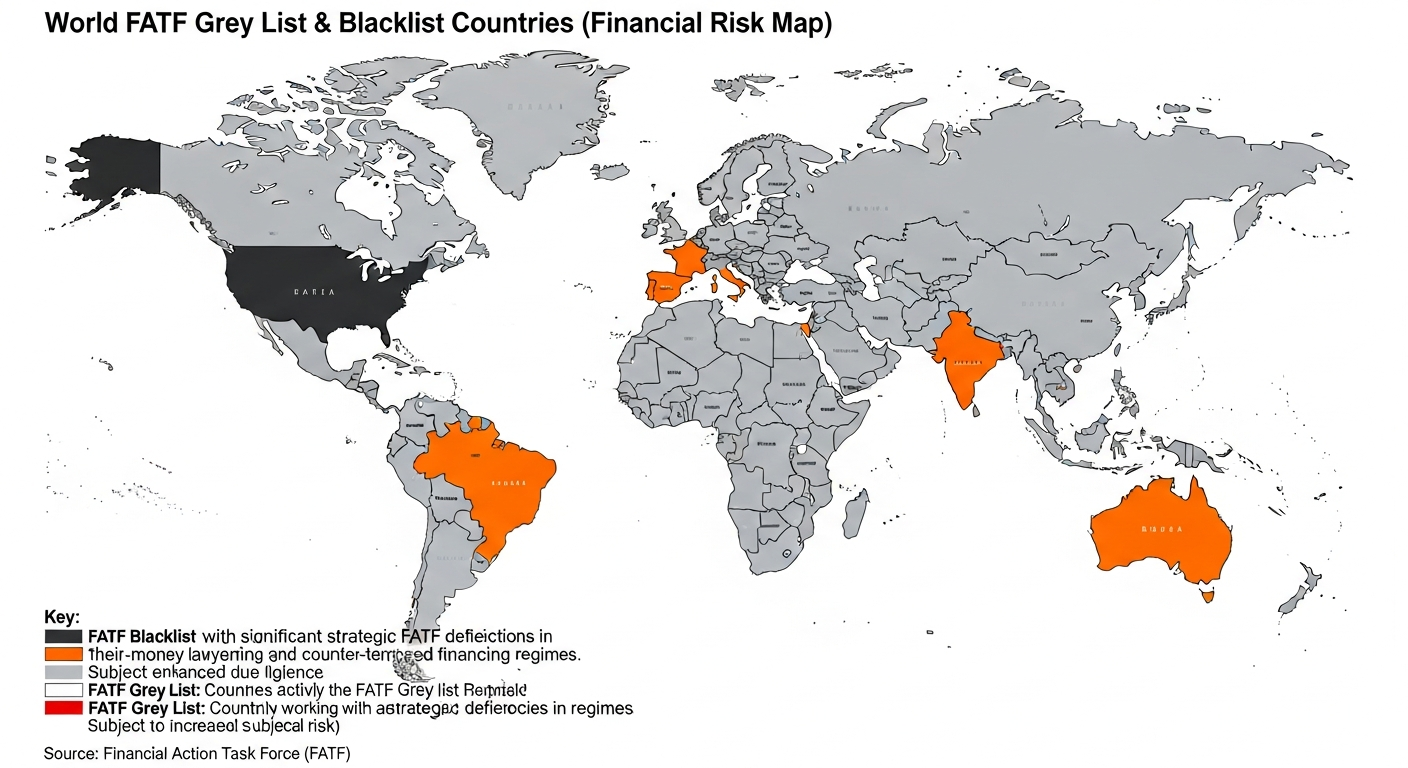
FATF Grey List Countries — Full List After the 19 June 2026 Plenary (22 Jurisdictions)
The FATF grey list — officially “Jurisdictions under Increased Monitoring” — identifies countries that have strategic deficiencies in their AML/CFT frameworks but are actively working with FATF to address them under an agreed action plan. Unlike the blacklist, grey-listed countries have committed to reform; grey-listing is designed as a temporary, remediation-focused status.
However, this distinction provides limited practical relief: grey-listing triggers mandatory Enhanced Due Diligence (EDD) requirements globally. Banks, payment processors, and financial institutions must apply higher scrutiny to all transactions involving grey-listed jurisdiction counterparties, significantly increasing costs and delays.
As of the 19 June 2026 FATF Plenary, the grey list contains 22 jurisdictions. Bosnia and Herzegovina and Iraq were added at that plenary, each having agreed an action plan with the FATF; Algeria and Namibia were removed after completing theirs:
| Country / Territory | Date Added | Primary AML/CFT Concerns |
|---|---|---|
| 🇦🇴 Angola | June 2023 | Weak AML framework; limited beneficial ownership reporting; deficiencies in oil sector-related financial flows |
| 🇧🇴 Bolivia | June 2025 | AML/CFT compliance deficiencies; narcotics trafficking proceeds risks; gaps in financial sector supervision |
| 🇧🇦 Bosnia and Herzegovina ⭐ New | June 2026 | Added at the June 2026 plenary; action plan agreed with the FATF to address strategic AML/CFT deficiencies |
| 🇧🇬 Bulgaria | October 2023 | Weaknesses in financial sector AML supervision; organized crime links; insufficient prosecution of high-level money laundering |
| 🇨🇲 Cameroon | June 2023 | Insufficient AML/CFT measures in the financial sector; weak beneficial ownership framework; limited international cooperation |
| 🇨🇮 Côte d’Ivoire | June 2022 | Gaps in AML/CFT framework; weak financial intelligence; limited effectiveness in prosecution of proceeds of crime |
| 🇨🇩 DR Congo | October 2022 | Serious deficiencies in understanding ML/TF risks; weak prosecution capacity; significant informal economy risks |
| 🇭🇹 Haiti | June 2020 | Political instability severely hampering AML/CFT implementation; corruption; limited financial sector supervision |
| 🇮🇶 Iraq ⭐ New | June 2026 | Added at the June 2026 plenary; action plan agreed with the FATF to address strategic AML/CFT deficiencies |
| 🇰🇪 Kenya | June 2024 | Deficiencies in supervision of designated non-financial businesses; gaps in beneficial ownership; limited asset recovery |
| 🇰🇼 Kuwait | February 2026 | Weak prosecution of money laundering; deficiencies in beneficial ownership transparency; limited effectiveness of AML supervision identified in 2024 MENAFATF MER |
| 🇱🇦 Laos (Lao PDR) | October 2021 | Significant ML/TF risks from narcotics; weak AML supervision; limited effectiveness of financial intelligence |
| 🇲🇱 Mali | February 2021 | Terrorism financing risks; political instability; insufficient prosecution of TF offences; weak financial intelligence |
| 🇲🇨 Monaco | February 2023 | Deficiencies in supervision of real estate and other high-risk sectors; beneficial ownership transparency gaps |
| 🇲🇿 Mozambique | June 2022 | Corruption and resource sector ML risks; weak AML enforcement; terrorism financing concerns in northern regions |
| 🇳🇬 Nigeria | February 2023 | Gaps in beneficial ownership; weak supervision of DNFBPs; limited effectiveness of ML/TF prosecution despite large financial sector |
| 🇵🇬 Papua New Guinea | February 2026 | Poor AML enforcement and limited convictions despite high risk; identified deficiencies in 2024 APG Mutual Evaluation Report |
| 🇵🇭 Philippines | June 2021 | Casino sector AML risks; deficiencies in DNFBP supervision; limited beneficial ownership transparency |
| 🇿🇦 South Africa | October 2023 | Significant capacity gaps in ML prosecution; weak supervision of high-risk sectors; state capture legacy issues |
| 🇸🇸 South Sudan | June 2021 | Nascent AML/CFT framework; severe institutional capacity constraints; corruption risks; conflict financing |
| 🇻🇪 Venezuela | June 2022 | Significant ML risks from corruption and drug trafficking proceeds; sanctions evasion risks; weak financial sector oversight |
| 🇻🇳 Vietnam | February 2023 | Gaps in AML/CFT supervision; weak beneficial ownership framework; limited effectiveness of financial intelligence unit |
Grey List vs. Blacklist: Key Differences Explained
While both lists identify jurisdictions with AML/CFT concerns, their implications differ fundamentally:
| Criterion | Grey List | Blacklist |
|---|---|---|
| Official Name | Jurisdictions under Increased Monitoring | High-Risk Jurisdictions — Call for Action |
| Cooperation | Actively cooperating with FATF on action plan | Non-cooperative or severely deficient |
| Required Response | Enhanced Due Diligence (EDD) mandatory | Counter-measures required (restrictions/bans) |
| Banking Impact | Higher scrutiny, delays, higher costs | Refused correspondent banking; blocked transactions |
| Path Out | Implement action plan → verified exit | Sustained reform + political will + verification |
What Happens When Your Counterparty Is in a FATF-Listed Country?
Grey-listing triggers mandatory Enhanced Due Diligence on every transaction involving that jurisdiction, but it is not a trade ban. Blacklisting is different: the FATF calls on all states to apply countermeasures, and most banks refuse the exposure outright. The practical effect is longer payment screening, more documentation and higher compliance cost — the specific obligations differ by list, and are set out below.
For Counterparties in Grey-Listed Countries
- Your bank will apply Enhanced Due Diligence (EDD) to all related transactions — expect requests for detailed source-of-funds documentation, business rationale explanations, and ultimate beneficial owner disclosures.
- Transaction processing is slower and more expensive — many banks apply manual review queues to transactions involving grey-listed countries, adding days or weeks to settlement times.
- Correspondent banking access is reduced — financial institutions serving grey-listed countries often face de-risking by their correspondent banks, meaning even routine cross-border wire transfers can fail.
- Investment limitations apply — institutional investors and fund managers often have internal policies restricting or prohibiting investments in grey-listed jurisdictions.
- Trade finance becomes more difficult — letters of credit, guarantees, and documentary credits are subject to heightened scrutiny, increasing costs and reducing availability.
For Counterparties in Blacklisted Countries
The situation is far more severe. Most banks and financial institutions will refuse any transaction involving counterparties from Iran, North Korea, or Myanmar. Beyond FATF obligations, Iran and North Korea are subject to comprehensive U.S. economic sanctions programs, EU sanctions, and UN Security Council sanctions. Any attempted transaction may constitute a sanctions violation — with civil and criminal penalties reaching hundreds of millions of dollars.
If you have existing business relationships, assets, or contractual obligations involving these jurisdictions, you should consult with sanctions compliance specialists immediately to understand your exposure and legal options.
How to Conduct Due Diligence with FATF-Listed Country Counterparties
While FATF grey-listed countries are not subject to outright transaction bans, conducting business with entities in these jurisdictions requires a robust, documented Enhanced Due Diligence process. Here is what compliance professionals and legal teams should implement:
Step 1: Screen Against All Relevant Lists
Before any engagement, screen the counterparty against FATF lists, OFAC SDN List, EU Consolidated List, UN Security Council sanctions lists, and national sanctions lists. Use an automated screening tool that receives real-time updates — manual screening is insufficient given the frequency of list changes. Our sanctions database screening review service can help you select and implement the right solution.
Step 2: Enhanced Customer Due Diligence (ECDD)
- Obtain and verify Ultimate Beneficial Owner (UBO) documentation — who ultimately owns or controls the counterparty entity?
- Conduct Politically Exposed Person (PEP) screening — are any owners, directors, or beneficial owners PEPs?
- Verify the source of funds and source of wealth — document how the funds for the transaction originated
- Obtain senior management approval before proceeding with high-risk transactions
Step 3: Ongoing Monitoring
FATF lists are updated three times per year. A counterparty that is clean today may be listed tomorrow. Implement ongoing transaction monitoring and periodic re-screening as part of your compliance program. If a counterparty’s country is newly added to the grey list, you must upgrade your due diligence level retroactively for existing relationships.
Step 4: Document Everything
In the event of a regulatory inquiry or enforcement action, your documentation of the EDD process can be the difference between a finding of non-compliance and a successful defense. Maintain records of all due diligence steps, approvals, and risk decisions for a minimum of five years — longer in many jurisdictions.
FATF List Changes 2024–2026: Countries Added and Removed
FATF updates its lists at each plenary session (typically February, June, and October). The following table summarizes the most significant changes over the past two years — essential reading for compliance teams monitoring counterparty risk.
| Country | Change | Date | Reason |
|---|---|---|---|
| Monaco | 🟡 Added to Grey List | February 2024 | Deficiencies in beneficial ownership transparency and real estate sector AML controls |
| Venezuela | 🟡 Added to Grey List | February 2024 | Weak AML/CFT supervision, lack of transparency in financial reporting |
| Kenya | ✅ Removed from Grey List | February 2024 | Completed action plan; demonstrated sustained improvements in AML/CFT effectiveness |
| Namibia | ✅ Removed from Grey List | February 2024 | Addressed key strategic deficiencies in its AML/CFT framework |
| Bulgaria | 🟡 Added to Grey List | October 2023 | Deficiencies in supervising DNFBPs (lawyers, accountants, real estate); first EU member state on grey list since 2010 |
| Cameroon | 🟡 Added to Grey List | October 2023 | Weak AML/CFT enforcement and supervision |
| Albania | ✅ Removed from Grey List | June 2024 | Completed required action items; demonstrated improved AML/CFT effectiveness |
| Barbados | ✅ Removed from Grey List | June 2024 | Addressed strategic deficiencies after 4 years on the list |
| Laos | ✅ Removed from Grey List | June 2024 | Demonstrated sufficient progress on its FATF action plan |
Note: FATF plenary sessions occur three times per year. Compliance teams should update their country risk ratings within 30 days of each plenary announcement. The next scheduled plenary is October 2026.
How Countries Get Added to and Removed from FATF Lists
Understanding the listing and delisting process is important for businesses monitoring country risk:
The Listing Process
Countries are identified through Mutual Evaluation Reports (MERs) — comprehensive peer reviews conducted by FATF and its regional bodies (FSRBs). MERs assess both the technical compliance of a country’s legal framework and the effectiveness of its implementation. Countries that receive poor ratings — particularly in effectiveness — may be placed on a follow-up process that ultimately leads to grey-listing if progress is insufficient.
The February 2026 additions of Kuwait (based on the 2024 MENAFATF MER) and Papua New Guinea (based on the 2024 APG MER) followed exactly this process: both countries received mutual evaluations showing significant deficiencies, and after follow-up review failed to demonstrate sufficient progress, FATF moved them to increased monitoring.
The Delisting Process
Delisting requires a country to demonstrate it has substantially addressed the action plan items identified at listing. This typically involves legislative reforms, regulatory capacity building, increased prosecutions, and asset recovery results. FATF conducts on-site visits to verify progress before delisting. The average time on the grey list is approximately 2–4 years, though some countries (like Haiti and South Sudan) have remained listed much longer due to ongoing political instability.

Implications for Specific Sectors
Banks and Financial Institutions
Banks face the most direct compliance obligations. Correspondent banks must apply EDD to respondent banks in grey-listed countries; many choose de-risking — terminating these relationships entirely — as the path of least regulatory resistance. This can cut off entire national banking systems from global finance, as has been seen repeatedly in Caribbean and African jurisdictions on the grey list.
Law Firms and Professional Services
Under FATF Recommendation 12 and 22, professional service providers — including lawyers, accountants, real estate agents, and trust and company service providers — are Designated Non-Financial Businesses and Professions (DNFBPs) subject to AML obligations. When acting for clients from grey-listed countries, lawyers must apply EDD requirements equivalent to financial institutions.
Import/Export and Trade Finance
Trade involving counterparties in FATF-listed countries is subject to heightened documentary requirements, delayed letter of credit approvals, and potential refusals from confirming banks. Companies should factor in additional compliance timelines when contracting with counterparties in grey-listed jurisdictions.
Investment and Private Equity
Fund managers typically face LP restrictions on investments in grey-listed countries, particularly for pension funds and sovereign wealth funds with strict mandate limitations. Even if not legally prohibited, reputational risk considerations often lead to internal prohibitions.

Message a sanctions lawyer on WhatsApp — confidential, reply within 24 hours.