



Message a sanctions lawyer on WhatsApp — confidential, reply within 24 hours.
Quick Answer: What Is the OFAC 50 Percent Rule?
The OFAC 50 Percent Rule automatically treats any entity as sanctioned if one or more blocked persons own 50% or more of it — directly or indirectly, in aggregate. This means a company can be subject to full US sanctions even without appearing on the SDN List. Violations carry civil penalties up to $1,000,000 per transaction and criminal liability of up to 20 years imprisonment.
Sanctions policy is a crucial tool that countries use to influence international relations, particularly in combating terrorism, human rights violations, and other threats. The primary body regulating sanctions in the USA is the Office of Foreign Assets Control (OFAC). One of the most consequential — and most misunderstood — aspects of OFAC’s work is the OFAC 50 Percent Rule, a regulation that automatically extends sanctions to entities owned by blocked persons, even if those entities are not named on any sanctions list. Understanding this rule is critical for any business operating internationally.
What Is the OFAC 50 Percent Rule?
The OFAC 50 Percent Rule is a policy implemented by the U.S. Office of Foreign Assets Control stating that any entity is treated as blocked — subject to the same US sanctions as formally designated SDNs — if one or more blocked persons own, in the aggregate, directly or indirectly, a 50% or greater interest in that entity. Critically, the entity does not need to appear on the SDN List to be subject to sanctions.
This rule was first codified in OFAC guidance in 2008, significantly clarified in 2014, and further updated in December 2022 to address indirect ownership chains through layered corporate structures. The legal basis flows from the International Emergency Economic Powers Act (IEEPA) and the Trading with the Enemy Act (TWEA), which grant OFAC broad authority to block property in which sanctioned parties have any interest.
The compliance burden falls entirely on businesses: OFAC does not publish a separate list of entities blocked solely under this rule. This makes the OFAC 50 Percent Rule one of the most challenging aspects of OFAC compliance — you must identify blocked entities through your own due diligence.
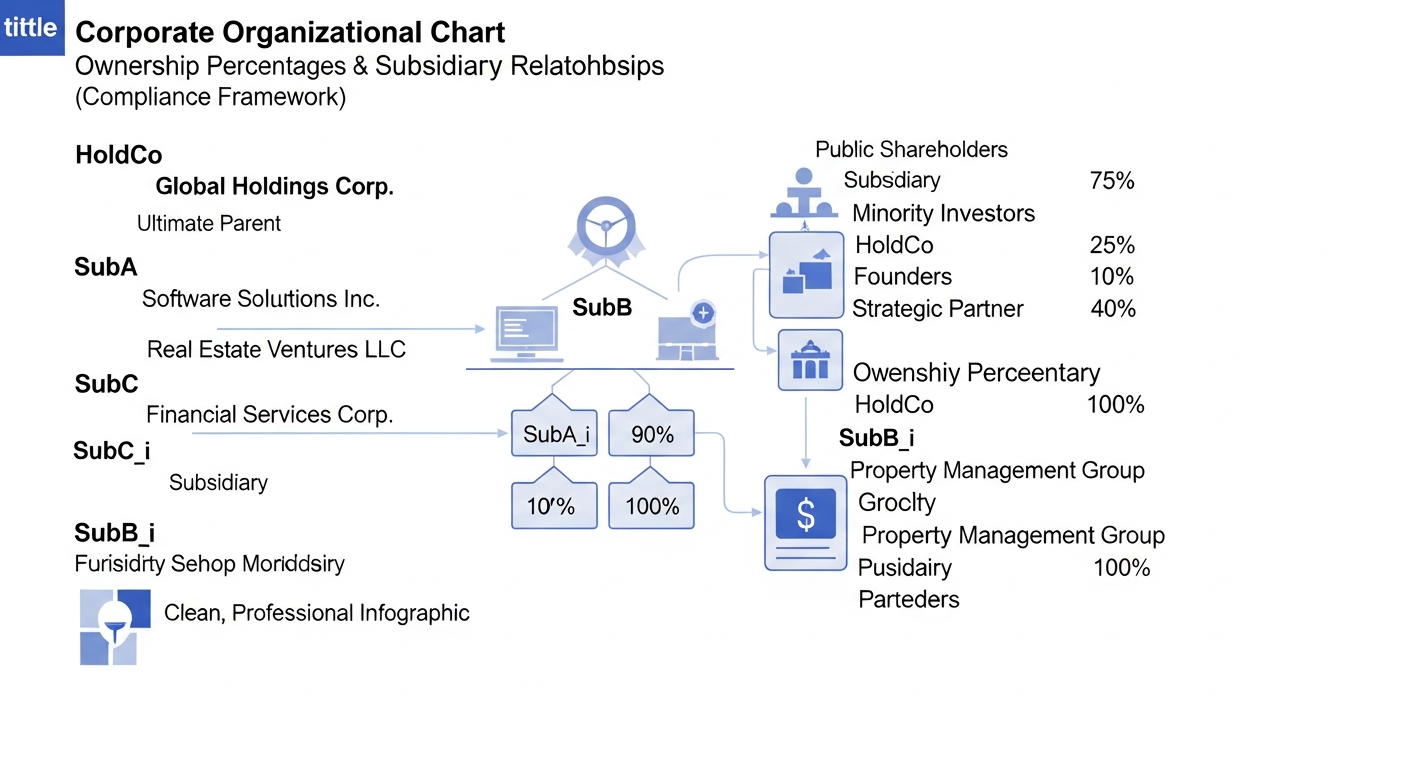
How Does the OFAC 50% Rule Work? Step-by-Step
Understanding the mechanics of the rule is essential for any compliance officer or international business. Here is how OFAC applies it in practice:
- Identify all blocked persons in the ownership chain. Start with the SDN List and all relevant sanctions programs. A “blocked person” includes any entity or individual designated on the SDN List, as well as any entity already blocked under the 50% Rule itself.
- Map the full ownership structure. For each counterparty, trace ownership up through every parent, holding company, and ultimate beneficial owner. Do not stop at one level — the rule applies through multiple layers of ownership.
- Calculate each blocked person’s direct ownership stake. This includes equity interests, shares, partnership interests, or any other form of legal or beneficial ownership.
- Calculate indirect ownership. If a blocked person owns ≥50% of an intermediate entity, that intermediate entity is itself blocked. The blocked person’s indirect stake in downstream entities is then calculated proportionally through that blocked intermediate.
- Aggregate ownership from all blocked persons. Add together the stakes of all blocked persons (direct + indirect). If the combined total reaches 50% or more, the entity is blocked.
- Apply the result. If blocked: freeze any assets within US jurisdiction, halt all transactions, and treat the entity identically to an SDN-listed party.
Example: A US tech company is evaluating a Russian software vendor. The vendor has three shareholders: SDN-listed oligarch A holds 20%, his daughter (also SDN-listed) holds 20%, and an unnamed third party holds 60%. Aggregate blocked ownership = 40%. The vendor is not automatically blocked. However, if A increases his stake to 30%, aggregate blocked ownership reaches 50% — and the vendor becomes automatically blocked overnight, even mid-contract.
Direct vs. Indirect Ownership Under the 50% Rule
The distinction between direct and indirect ownership is central to understanding the OFAC 50 Percent Rule. The December 2022 OFAC guidance significantly tightened the indirect ownership analysis.
| Ownership Type | Definition | Example | Result |
|---|---|---|---|
| Direct | Blocked person holds shares/equity directly in the target entity | SDN X owns 60% of Company A | ⛔ Company A is BLOCKED |
| Indirect (single chain) | Blocked person owns ≥50% of an intermediary, which owns a stake in the target | SDN X owns 60% of A; A owns 70% of B | ⛔ Both A and B are BLOCKED |
| Indirect (broken chain) | Blocked person owns <50% of intermediary — chain does not propagate | SDN X owns 40% of A; A owns 80% of B | ✅ B is NOT blocked via this path |
| Mixed direct + indirect | Blocked person has both direct stake and indirect stake via a blocked intermediary | SDN X owns 30% direct + 25% indirect via blocked A | ⛔ Aggregate 55% — BLOCKED |
Key principle: Once an intermediary entity is itself blocked (because ≥50% of it is owned by blocked persons), it is treated as a blocked person for purposes of calculating downstream ownership. This allows the rule to propagate through complex corporate chains.
Aggregation: When Multiple Blocked Persons Own a Company
The OFAC aggregate ownership rule is one of the most overlooked compliance pitfalls. Even if no single blocked person owns 50% of an entity, the combined stakes of multiple blocked persons are added together. If the aggregate reaches 50%, the entity is blocked.
| Scenario | Ownership Structure | Aggregate % by Blocked Persons | Result |
|---|---|---|---|
| Simple direct ownership | Blocked Person X owns 60% of Company A | 60% direct | ⛔ Company A is BLOCKED |
| Exactly at threshold | Blocked Person X owns 50% of Company B | 50% direct | ⛔ Company B is BLOCKED |
| Multiple blocked owners — aggregate triggers block | Blocked X owns 25% + Blocked Y owns 25% of Company C | 50% aggregate | ⛔ Company C is BLOCKED |
| Three blocked owners — combined majority | SDN A: 20%, SDN B: 15%, SDN C: 15% of Company D | 50% aggregate | ⛔ Company D is BLOCKED |
| Indirect chain | Blocked X owns 60% of A; A owns 60% of B | 60% indirect (via blocked A) | ⛔ Company B is BLOCKED |
| Below threshold — single owner | Blocked X owns 40% of Company E | 40% — below 50% | ✅ Company E is NOT automatically blocked |
| Sub-50% intermediary — chain broken | Blocked X owns 40% of A; A owns 60% of B | X’s indirect stake in B: 24% | ✅ Company B is NOT automatically blocked via this path |
Note: OFAC’s aggregation applies even to blocked persons from different sanctions programs. An SDN listed under Russia sanctions and another listed under Iran sanctions can, together, trigger the 50% rule for the same entity.
SDN List vs. OFAC 50% Rule: Key Differences
| Feature | SDN List (Direct Designation) | OFAC 50% Rule (Automatic Block) |
|---|---|---|
| Published by OFAC? | Yes — publicly listed on SDN List | No — not published; must be calculated |
| How entity becomes blocked | OFAC formally designates the entity | Automatic — once ownership threshold is met |
| Compliance responsibility | Screen against published list | Must conduct independent ownership analysis |
| Applies to subsidiaries? | Not automatically | Yes — if 50%+ owned by blocked persons |
| Updated by OFAC? | Yes — OFAC updates SDN List regularly | No — changes when ownership structure changes |
| Penalties for violation | Up to $1,000,000 or 2× transaction value | Up to $1,000,000 or 2× transaction value |
| Criminal liability? | Yes — up to 20 years imprisonment | Yes — up to 20 years imprisonment |
Real-World Example Cases
While OFAC does not publish a list of entities blocked solely under the 50% Rule, enforcement actions consistently reveal how the rule operates in practice. The following scenarios illustrate common violations:
Case 1: The Hidden Subsidiary Problem
A European trading company entered into a long-term supply agreement with a logistics firm registered in the UAE. Standard SDN List screening showed no red flags. However, a beneficial ownership investigation later revealed that a Russian national — listed on the SDN List under the Ukraine-related sanctions program — held a 55% equity stake in the UAE firm through a Cypriot holding company. The UAE firm had never been formally designated by OFAC. Under the 50% Rule, it was automatically blocked. The European company faced potential US secondary sanctions exposure for continuing to process dollar-denominated payments through US correspondent banks.
Case 2: The Aggregation Trap
A US investment fund conducted due diligence on a Central Asian mining company. Two individual shareholders were identified as SDN-listed — one holding 22% and another holding 29%. Each stake individually fell below the 50% threshold. The compliance team — screening only against the SDN List and applying the rule on a per-person basis — cleared the transaction. But OFAC’s aggregation rule requires combining all blocked-person ownership: 22% + 29% = 51%. The mining company was automatically blocked. The fund’s transaction constituted a prohibited dealing with a blocked entity, resulting in a significant civil enforcement action.
Case 3: Mid-Contract Designation Cascade
A US technology licensor had a valid, long-running agreement with a software distributor in Southeast Asia. Partway through the contract, OFAC added the distributor’s majority shareholder (who held 65%) to the SDN List as part of a Russia-related enforcement action. The moment of designation automatically triggered the 50% Rule: the distributor became a blocked entity instantly. The US company was required to immediately suspend performance and freeze any pending payments — even though the original contract predated the designation. Continued performance without an OFAC license would have constituted a violation.
How to Check If a Company Is Blocked Under the OFAC 50% Rule
Because OFAC does not publish a list of 50% Rule-blocked entities, identifying them requires active due diligence. Here are the practical steps businesses should take:
- Screen all counterparties against the SDN List — the starting point is always the full SDN List and all OFAC-administered sanctions lists (CAPTA, FSE, NS-ISA, etc.).
- Request beneficial ownership disclosure. Ask counterparties for UBO (Ultimate Beneficial Owner) declarations, ideally certified or backed by corporate registry extracts. For high-risk jurisdictions, require documentation down to the natural-person level.
- Consult corporate registries. Check national company registries, Companies House equivalents, or data aggregators (OpenCorporates, Orbis, Refinitiv) for shareholder information.
- Screen all identified owners against sanctions lists. Once you have the shareholder list, run every owner — individual and corporate — against the SDN List and other OFAC lists.
- Aggregate blocked-person ownership. Add together all stakes held by SDN-listed or otherwise blocked persons. If the total reaches or exceeds 50%, the entity is blocked regardless of SDN List status.
- Trace indirect chains. For any intermediary company, repeat the analysis one level up. If a blocked person owns ≥50% of an intermediate holding company, treat that holding company as blocked and count its downstream stakes accordingly.
- Document your analysis. Retain records of your ownership tracing, data sources, and conclusions. In any enforcement review, documented good-faith due diligence is a significant mitigating factor.
- Re-screen periodically and on trigger events. Sanctions designations happen without notice. Monitor for ownership changes, new SDN designations, and corporate restructurings that could alter a counterparty’s status mid-relationship.
For complex corporate structures — particularly those involving Russian, Iranian, Venezuelan, Belarusian, or North Korean nexus — consider engaging OFAC lawyers to conduct or review the ownership analysis before transacting.
Common Compliance Mistakes Under the OFAC 50% Rule
Even well-resourced compliance teams make errors with the OFAC 50 Percent Rule. These are the most common pitfalls:
- Relying solely on SDN List screening. The single biggest mistake. SDN List screening will not reveal 50% Rule-blocked entities. Ownership analysis is mandatory.
- Failing to aggregate across multiple blocked persons. Applying the 50% threshold on a per-person rather than aggregate basis misses the most common violation scenario.
- Stopping at one level of ownership. Indirect chains must be traced through multiple layers. A holding company that looks clean at first glance may have a blocked person two levels up.
- Ignoring minority-stake SDNs as “harmless.” A 30% SDN stake is not automatically safe — there may be other blocked persons whose stakes aggregate with it to cross 50%.
- Not re-screening after new designations. OFAC adds SDN designations regularly. A counterparty that was clean last quarter may be blocked today if a shareholder was newly designated.
- Confusing control with ownership. An SDN who “controls” an entity but owns less than 50% does not automatically trigger the 50% Rule — but may expose your counterparty to separate OFAC designation risk, warranting heightened scrutiny.
- Assuming non-US companies are safe. The 50% Rule applies to US persons transacting with blocked entities, regardless of where those entities are incorporated.
- Not having an escalation procedure for ambiguous ownership. When ownership data is incomplete or inconclusive, there should be a defined process — including legal review — before proceeding.
Why Was the OFAC 50 Percent Rule Implemented?
The OFAC 50 Percent Rule was designed to prevent sanctioned individuals and organizations from evading US sanctions by concealing their ownership through complex corporate structures. Without this rule, a Russian oligarch on the SDN List could simply create a new subsidiary — not listed on the SDN List — and conduct business freely through it.
In December 2022, OFAC significantly updated the rule to clarify that indirect ownership chains are fully covered: if a blocked person owns 50% or more of an intermediate company, and that company owns any stake in another entity, the blocked person’s proportional indirect ownership is counted toward the 50% threshold in the downstream entity. This update closed a major loophole that had allowed sanctions evasion through multi-layered corporate structures, particularly relevant following expanded Russia sanctions.
Penalties for Violating the OFAC 50% Rule
Violating the OFAC 50 Percent Rule — by transacting with an entity that is automatically blocked even without SDN listing — can result in severe civil and criminal penalties:
- Civil penalty: Up to $1,000,000 per violation, or twice the value of the transaction — whichever is greater
- Criminal penalty: Up to $1,000,000 fine and/or 20 years imprisonment for willful violations
- Asset freezing: Immediate blocking of all related assets within US jurisdiction
- Reputational damage: Public enforcement actions and loss of banking relationships
Importantly, OFAC applies strict liability for civil violations — meaning you can be penalized even if you had no intent to violate the rule. However, voluntary self-disclosure and strong compliance programs can significantly reduce penalties.
What to Do If You Discover a 50% Rule Violation
If your compliance review reveals that you have transacted — or are currently transacting — with an entity blocked under the OFAC 50 Percent Rule, act immediately and systematically:
- Stop all ongoing transactions immediately. Do not process any further payments, deliveries, or services to or from the blocked entity. Continuing to perform after discovery dramatically increases penalty exposure.
- Block and freeze all assets. Any property of the blocked entity within US jurisdiction — including funds held in accounts, goods in transit, or pending wire transfers — must be frozen immediately. Report blocked property to OFAC within 10 business days of blocking.
- Preserve all records. Gather and secure all documentation related to the transaction(s): contracts, invoices, payment records, due diligence files, correspondence. These will be critical in any enforcement proceeding or VSD submission.
- Engage OFAC sanctions counsel. Before taking any further action — including contacting OFAC — consult with an OFAC lawyer. The way you respond in the first 72 hours significantly affects your ultimate liability.
- Consider Voluntary Self-Disclosure (VSD). OFAC’s enforcement guidelines provide for significantly reduced penalties when violations are voluntarily disclosed before OFAC initiates an inquiry. VSD must be made through a carefully structured submission — your counsel can assess whether VSD is appropriate and prepare the disclosure.
- Apply for a specific license if needed. In some cases, OFAC will issue a specific license to wind down transactions, return assets, or take other necessary steps involving a blocked party. Your attorney can prepare and submit the license application.
- Remediate your compliance program. Identify how the violation occurred — was it a screening gap, an ownership analysis failure, or a process breakdown? Fix it. OFAC considers remediation a significant mitigating factor in penalty determinations.
Companies that discover a 50 Percent Rule compliance gap face potentially significant financial exposure. Use our OFAC penalty calculator to estimate potential penalty ranges based on transaction values, violation counts, and applicable mitigating factors — then consult our sanctions lawyers to develop a response strategy that minimises your liability.
Discovered a Potential 50% Rule Violation?
Time is critical. Our OFAC lawyers have handled 500+ enforcement cases including complex ownership analysis, voluntary self-disclosure submissions, and defense before OFAC. Get a confidential consultation — the sooner you act, the more options you have.
How to Comply with the OFAC 50 Percent Rule
Compliance with the OFAC 50% rule requires going beyond simple SDN list screening. Our OFAC lawyers recommend the following measures:
- Conduct deep ownership due diligence: Map the full beneficial ownership structure of counterparties — not just direct shareholders
- Aggregate ownership across multiple blocked persons: A 25% stake from two different SDN-listed parties equals 50% and triggers blocking
- Screen indirect ownership chains: Follow corporate structures multiple levels deep, especially in Russia, Iran, Venezuela, and Belarus
- Monitor ownership changes: An entity can become automatically blocked mid-relationship if a blocked person acquires a sufficient stake
- Use enhanced screening software: Standard SDN list screening tools do not automatically flag 50% rule entities — specialized tools or manual analysis required
- Train compliance staff: Ensure staff understand the rule applies even without SDN listing
- Document everything: Retain records of ownership analysis, data sources, and conclusions for every counterparty
Message a sanctions lawyer on WhatsApp — confidential, reply within 24 hours.